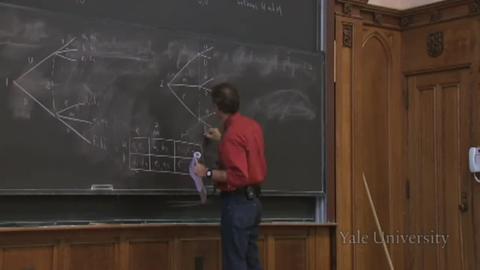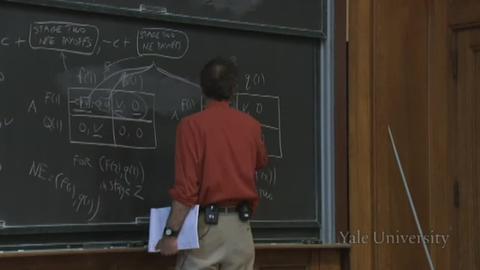
We develop a simple model of bargaining, starting from an ultimatum game (one person makes the other a take it or leave it offer), and building up to alternating offer bargaining (where players can make counter-offers). On the way, we introduce discounting: a dollar tomorrow is worth less than a dollar today. We learn that, if players are equally patient, if offers can be in rapid succession, and if each side knows how much the game is worth to the other side, then the first offer is for an equal split of the pie and this offer is accepted. But this result depends on those assumptions; for example, bargaining power may depend on wealth.
00:00:00 Ultimatum Games: Why Backward Induction Fails Here
00:14:15 Bargaining Games: Setup and Generalization
00:47:44 Bargaining Games: Summary of Proof of Generalization
00:54:29 Bargaining Games: Assumptions and Conclusions
Source: Ben Polak, Game Theory (Yale University: Open Yale Courses). Licensed under CC BY-NC-SA 3.0.

Hypha Learn
Free university lectures and educational content, curated and republished from public sources.
This course is an introduction to game theory and strategic thinking. Ideas such as dominance, backward induction, Nash equilibrium, evolutionary stability, commitment, credibility, asymmetric information, adverse selection, and signaling are discussed and applied to games played in class and to examples drawn from economics, politics, the movies, and elsewhere.
-
Lecture 1 - Introduction: Five First Lessons1:08:32 Free
-
-
-
-
-
Lecture 6 - Nash Equilibrium: Dating and Cournot1:12:05 Free
-
-
-
Lecture 9 - Mixed Strategies in Theory and Tennis1:12:52 Free
-
-
-
-
-
-
-
-
-
-
-
-
-
-
-