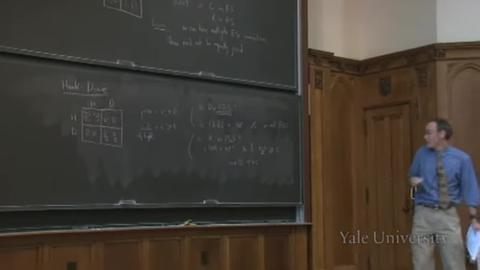
We apply the idea of evolutionary stability to consider the evolution of social conventions. Then we consider games that involve aggressive (Hawk) and passive (Dove) strategies, finding that sometimes, evolutionary populations are mixed. We discuss how such games can help us to predict how behavior might vary across settings. Finally, we consider a game in which there is no evolutionary stable population and discuss an example from nature.
00:00:00 Monomorphic and Polymorphic Populations Theory: Definition
00:30:50 Monomorphic and Polymorphic Populations Theory: Hawk vs. Dove
00:50:00 Monomorphic and Polymorphic Populations Theory: Discussion
00:55:39 Monomorphic and Polymorphic Populations Theory: Identification and Testability
Source: Ben Polak, Game Theory (Yale University: Open Yale Courses). Licensed under CC BY-NC-SA 3.0.

Hypha Learn
Free university lectures and educational content, curated and republished from public sources.
This course is an introduction to game theory and strategic thinking. Ideas such as dominance, backward induction, Nash equilibrium, evolutionary stability, commitment, credibility, asymmetric information, adverse selection, and signaling are discussed and applied to games played in class and to examples drawn from economics, politics, the movies, and elsewhere.
-
Lecture 1 - Introduction: Five First Lessons1:08:32 Free
-
-
-
-
-
Lecture 6 - Nash Equilibrium: Dating and Cournot1:12:05 Free
-
-
-
Lecture 9 - Mixed Strategies in Theory and Tennis1:12:52 Free
-
-
-
-
-
-
-
-
-
-
-
-
-
-
-