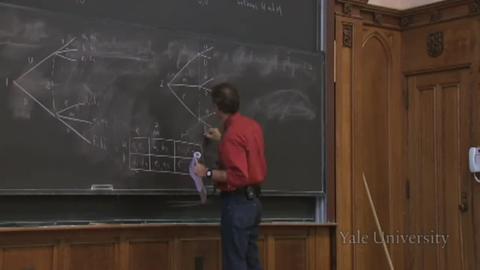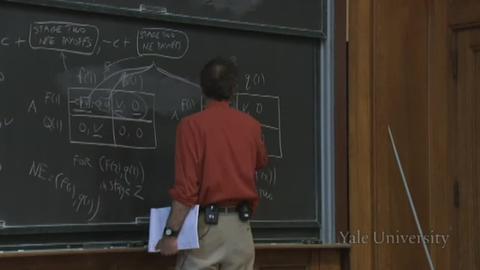
We look at two settings with asymmetric information; one side of a game knows something that the other side does not. We should always interpret attempts to communicate or signal such information taking into account the incentives of the person doing the signaling. In the first setting, information is verifiable. Here, the failure explicitly to reveal information can be informative, and hence verifiable information tends to come out even when you don't want it to. We consider examples of such information unraveling. Then we move to unverifiable information. Here, it is hard to convey such information even if you want to. Nevertheless, differentially costly signals can sometimes provide incentives for agents with different information to distinguish themselves. In particular, we consider how the education system can allow future workers to signal their abilities. We discuss some implications of this rather pessimistic view of education.
00:00:00 Asymmetric Information: Signaling and Information Unraveling
00:16:48 Information Unraveling: Examples
00:35:07 Signaling: Good and Bad Workers
00:59:36 Signaling: Conclusions
Source: Ben Polak, Game Theory (Yale University: Open Yale Courses). Licensed under CC BY-NC-SA 3.0.

Hypha Learn
Free university lectures and educational content, curated and republished from public sources.
This course is an introduction to game theory and strategic thinking. Ideas such as dominance, backward induction, Nash equilibrium, evolutionary stability, commitment, credibility, asymmetric information, adverse selection, and signaling are discussed and applied to games played in class and to examples drawn from economics, politics, the movies, and elsewhere.
-
Lecture 1 - Introduction: Five First Lessons1:08:32 Free
-
-
-
-
-
Lecture 6 - Nash Equilibrium: Dating and Cournot1:12:05 Free
-
-
-
Lecture 9 - Mixed Strategies in Theory and Tennis1:12:52 Free
-
-
-
-
-
-
-
-
-
-
-
-
-
-
-