Lecture 13 - Sequential Games: Moral Hazard, Incentives, and Hungry Lions
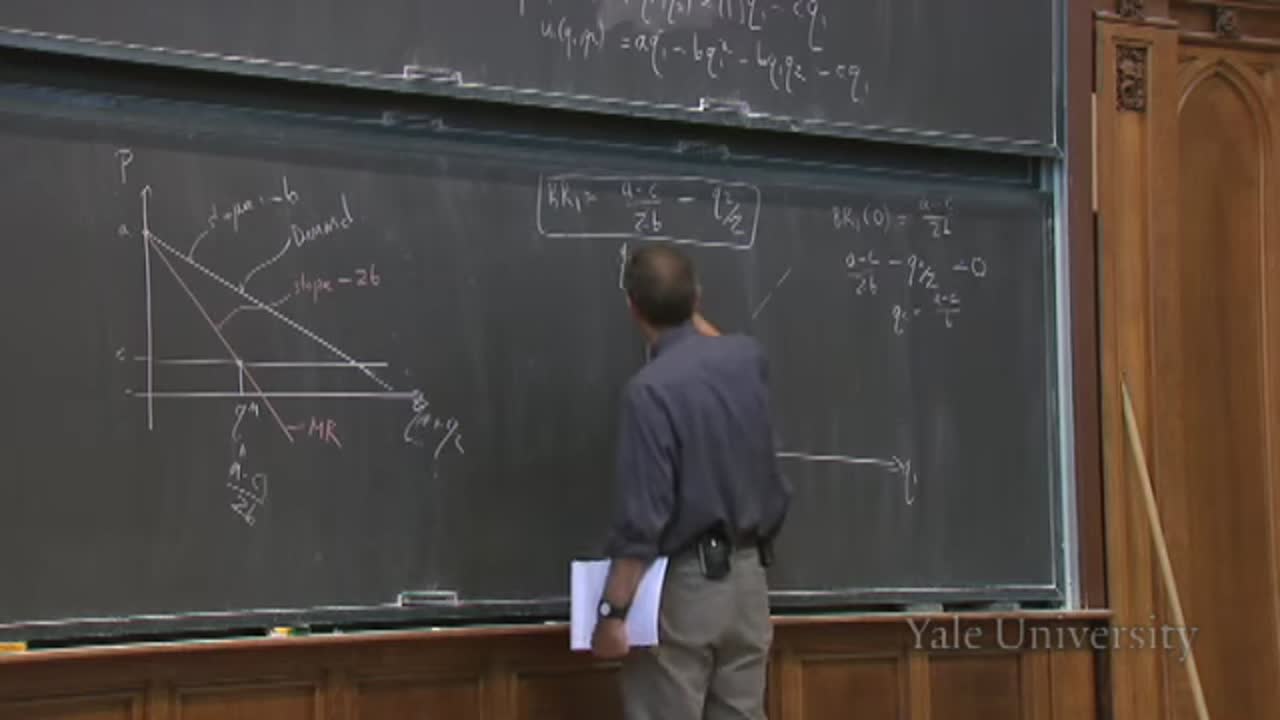
We consider games in which players move sequentially rather than simultaneously, starting with a game involving a borrower and a lender. We analyze the game using "backward induction." The game features moral hazard: the borrower will not repay a large loan. We discuss possible remedies for this kind of problem. One remedy involves incentive design: writing contracts that give the borrower an incentive to repay. Another involves commitment strategies; in this case providing collateral. We consider other commitment strategies such as burning boats. But the key lesson of the day is the idea of backward induction.
📑 Lecture Chapters:
Sequential Games: Backward Induction [00:00:00]
Sequential Games: Moral Hazard [00:17:57]
Sequential Games: Incentive Design [00:29:50]
Sequential Games: Commitment Strategies [00:44:29]
Sequential Games: Backward Induction Is Really Important [01:01:06]
Source: Ben Polak, Game Theory (Yale University: Open Yale Courses). Licensed under CC BY-NC-SA 3.0.

Hypha Official
Watch what matters. Create what pays.
This course is an introduction to game theory and strategic thinking. Ideas such as dominance, backward induction, Nash equilibrium, evolutionary stability, commitment, credibility, asymmetric information, adverse selection, and signaling are discussed and applied to games played in class and to examples drawn from economics, politics, the movies, and elsewhere.
-
Lecture 1 - Introduction: Five First Lessons1:08:32 Free
-
-
-
-
-
Lecture 6 - Nash Equilibrium: Dating and Cournot1:12:05 Free
-
-
-
Lecture 9 - Mixed Strategies in Theory and Tennis1:12:52 Free
-
-
-
-
-
-
-
-
-
-
-
-
-
-
-