Lecture 11 - Evolutionary Stability: Cooperation, Mutation, and Equilibrium
We discuss evolution and game theory, and introduce the concept of evolutionary stability. We ask what kinds of strategies are evolutionarily stable, and how this idea from biology relates to concepts from economics like domination and Nash equilibrium. The informal argument relating these ideas toward at the end of his lecture contains a notation error [U(Ŝ,S') should be U(S',Ŝ)]. A more formal argument is provided in the supplemental notes
📑 Lecture Chapters:
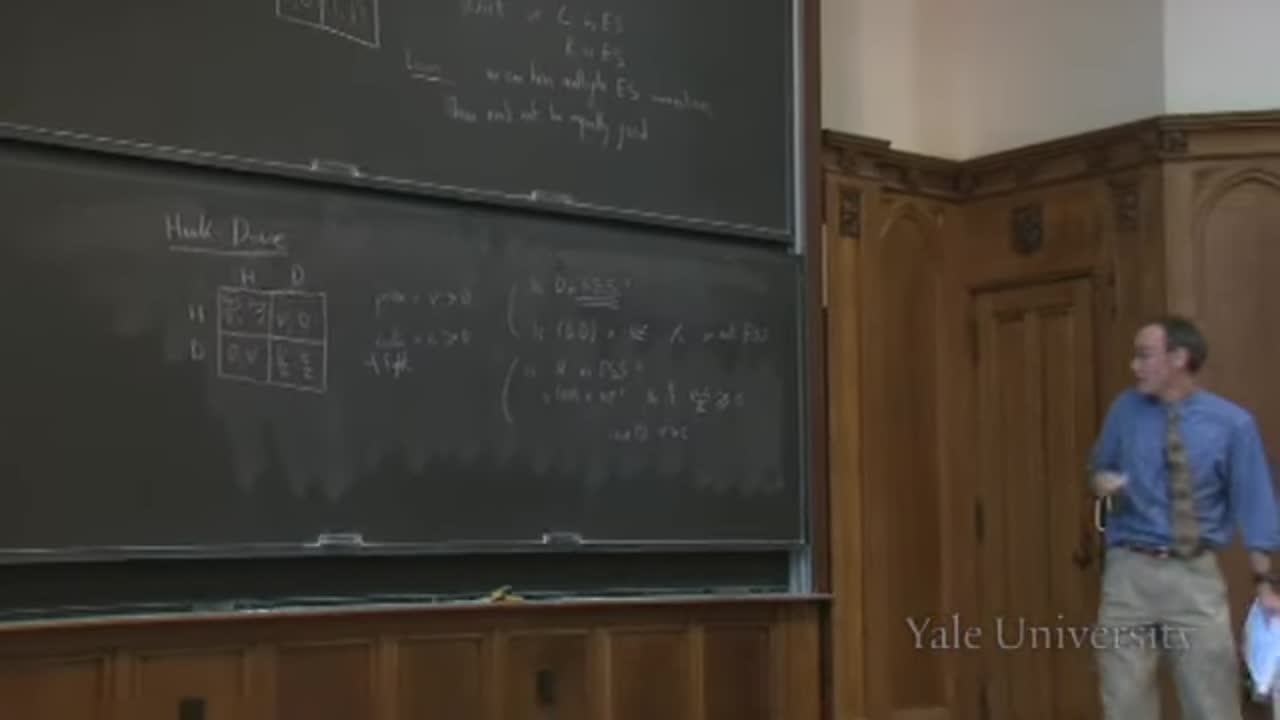
Game Theory and Evolution: Evolutionarily Stable Strategies - Example [00:00:00]
Game Theory and Evolution: Evolutionarily Stable Strategies - Discussion [00:25:40]
Game Theory and Evolution: Evolutionarily Stable Strategies Are Always Nash Equilibria [00:30:42]
Game Theory and Evolution: Nash Equilibria Are Not Always Evolutionarily Stable Strategies [00:42:32]
Game Theory and Evolution: Evolutionarily Stable Strategies and Nash Equilibria - Discussion [01:03:00]
Source: Ben Polak, Game Theory (Yale University: Open Yale Courses). Licensed under CC BY-NC-SA 3.0.

Hypha Official
Watch what matters. Create what pays.
This course is an introduction to game theory and strategic thinking. Ideas such as dominance, backward induction, Nash equilibrium, evolutionary stability, commitment, credibility, asymmetric information, adverse selection, and signaling are discussed and applied to games played in class and to examples drawn from economics, politics, the movies, and elsewhere.
-
Lecture 1 - Introduction: Five First Lessons1:08:32 Free
-
-
-
-
-
Lecture 6 - Nash Equilibrium: Dating and Cournot1:12:05 Free
-
-
-
Lecture 9 - Mixed Strategies in Theory and Tennis1:12:52 Free
-
-
-
-
-
-
-
-
-
-
-
-
-
-
-