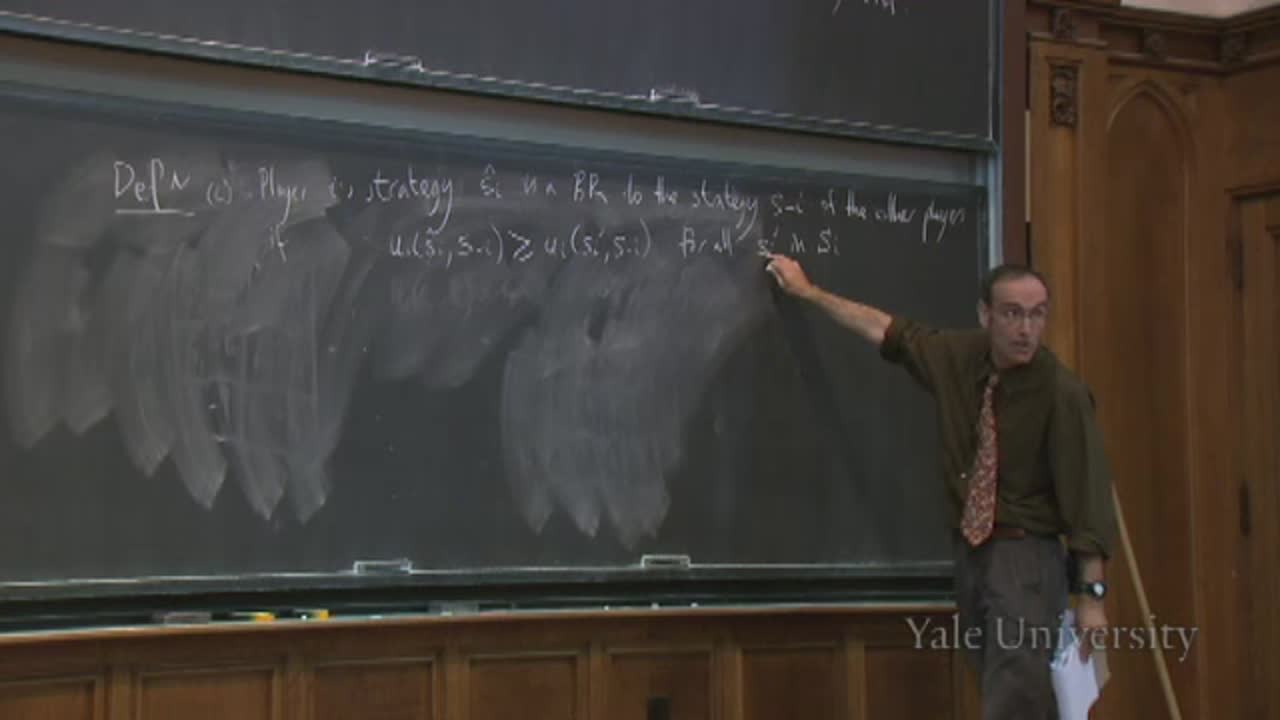
Lecture 9 - Mixed Strategies in Theory and Tennis
We continue our discussion of mixed strategies. First we discuss the payoff to a mixed strategy, pointing out that it must be a weighed average of the payoffs to the pure strategies used in the mix. We note a consequence of this: if a mixed strategy is a best response, then all the pure strategies in the mix must themselves be best responses and hence indifferent. We use this idea to find mixed-strategy Nash equilibria in a game within a game of tennis.
📑 Lecture Chapters:
Mixed Strategies: Definition [00:00:00]
Mixed Strategies: Examples [00:06:02]
Mixed Strategies: Direct and Indirect Effects on the Nash Equilibrium [00:22:20]
Mixed Strategies and the Nash Equilibrium: Example [00:27:05]
Source: Ben Polak, Game Theory (Yale University: Open Yale Courses). Licensed under CC BY-NC-SA 3.0.

Hypha Official
Watch what matters. Create what pays.
This course is an introduction to game theory and strategic thinking. Ideas such as dominance, backward induction, Nash equilibrium, evolutionary stability, commitment, credibility, asymmetric information, adverse selection, and signaling are discussed and applied to games played in class and to examples drawn from economics, politics, the movies, and elsewhere.
-
Lecture 1 - Introduction: Five First Lessons1:08:32 Free
-
-
-
-
-
Lecture 6 - Nash Equilibrium: Dating and Cournot1:12:05 Free
-
-
-
Lecture 9 - Mixed Strategies in Theory and Tennis1:12:52 Free
-
-
-
-
-
-
-
-
-
-
-
-
-
-
-