Lecture 16 - Backward Induction: Reputation and Duels
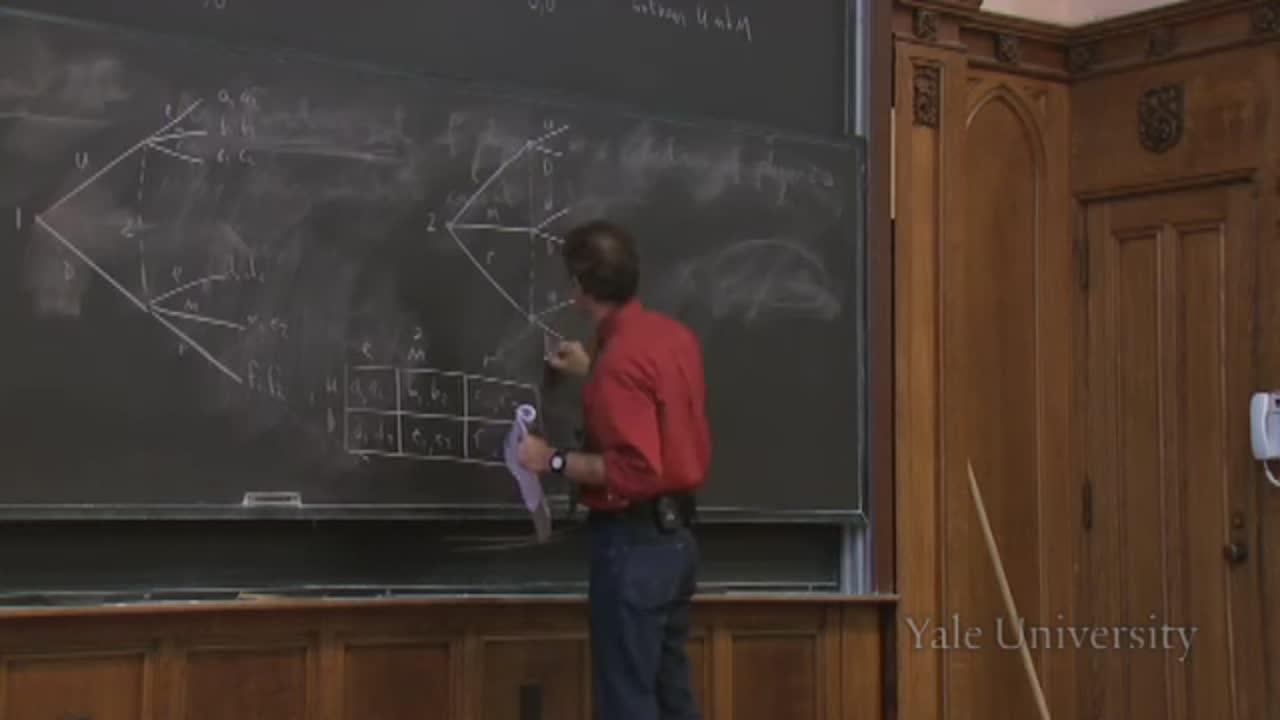
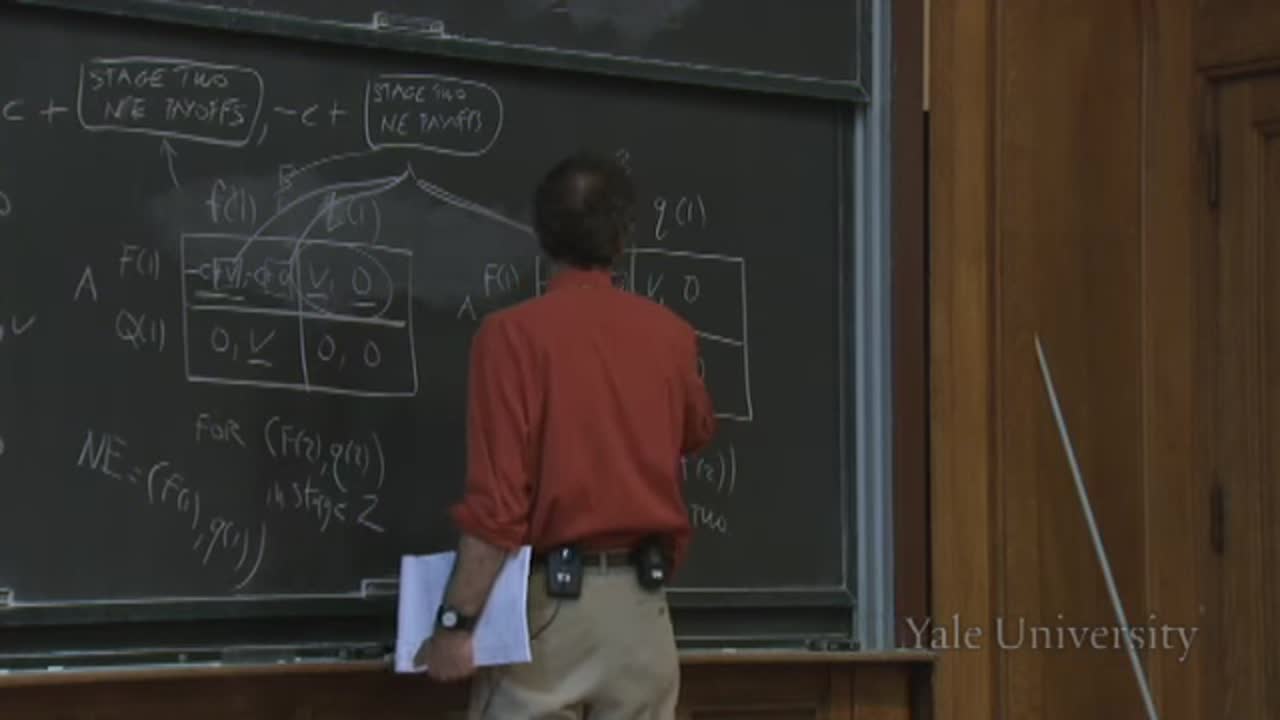
In the first half of the lecture, we consider the chain-store paradox. We discuss how to build the idea of reputation into game theory; in particular, in setting like this where a threat or promise would otherwise not be credible. The key idea is that players may not be completely certain about other players' payoffs or even their rationality. In the second half of the lecture, we stage a duel, a game of pre-emption. The key strategic question in such games is when; in this case, when to fire. We use two ideas from earlier lectures, dominance and backward induction, to analyze the game. Finally we discuss two biases found in Americans: overconfidence and over-valuing being pro-active.
📑 Lecture Chapters:
Establishing a Reputation: Selten's Chain Store Paradox [00:00:00]
Establishing a Reputation: Discussion [00:20:56]
Dueling: Game Setup [00:25:18]
Dueling: Game Analysis [00:34:04]
Dueling: Finding a Solution [00:45:42]
Dueling: Generalization [01:11:24]
Source: Ben Polak, Game Theory (Yale University: Open Yale Courses). Licensed under CC BY-NC-SA 3.0.

Hypha Official
Watch what matters. Create what pays.
This course is an introduction to game theory and strategic thinking. Ideas such as dominance, backward induction, Nash equilibrium, evolutionary stability, commitment, credibility, asymmetric information, adverse selection, and signaling are discussed and applied to games played in class and to examples drawn from economics, politics, the movies, and elsewhere.
-
Lecture 1 - Introduction: Five First Lessons1:08:32 Free
-
-
-
-
-
Lecture 6 - Nash Equilibrium: Dating and Cournot1:12:05 Free
-
-
-
Lecture 9 - Mixed Strategies in Theory and Tennis1:12:52 Free
-
-
-
-
-
-
-
-
-
-
-
-
-
-
-